

How Muscle Hypertrophy Really Works
Welcome back Wolf Pack! I’m happy to see you again and thank you for taking the time to read these blogs. Let’s get into it!
When you lift weights or challenge your body with resistance, your muscles don’t instantly get bigger — they adapt through a biological process called muscle hypertrophy. But what does that mean? What’s really happening in your body? Let’s delve into that!
What is Muscle Hypertrophy?
Muscle hypertrophy refers to the increase in the size of muscle fibers, not the number of fibers. Your body achieves this by synthesizing new proteins within existing muscle cells. A process that requires mechanical tension, muscle damage, and metabolic stress.
There are two main types of hypertrophy:
Myofibrillar Hypertrophy: Increases the size and number of myofibrils — the contractile units of muscle (the structures in your muscle fibers that actually create movement by contracting and generating force). Leading to denser and stronger muscle.
Sarcoplasmic Hypertrophy: Increases the fluid and energy storage components around the myofibrils, giving muscles a fuller appearance (common in bodybuilders).
The Three Triggers of Muscle Growth
Research identifies three major factors that stimulate hypertrophy:
A. Mechanical Tension
This is the tension your muscles experience during resistance training. Lifting heavy weights (especially through full range of motion and controlled eccentric movement) creates high tension that signals your body to build stronger fibers.
B. Muscle Damage
That post-workout soreness (DOMS) isn’t just discomfort — it’s your body responding to micro-tears in muscle fibers. Repairing these fibers causes them to come back thicker and stronger.
| However, excessive damage can slow recovery and limit growth, so progressive overload should be gradual, not extreme.
C. Metabolic Stress
Think of the “pump” or “fullness” you feel mid-workout — that’s metabolic stress. It comes from trapped blood, lactic acid, and metabolite buildup during high-rep sets or short rest periods. This stress triggers call swelling and hormonal responses (like IGF-1 release) that further encourage hypertrophy.
Protein Synthesis vs. Protein Breakdown
For muscles to grow, muscle protein synthesis (MPS) must exceed muscle protein breakdown (MPB). Resistance training spikes muscle protein breakdown for 24-48 hours post-workout, and adequate protein intake is crucial during this window. A 2016 paper in Frontiers in Physiology showed that consuming 1.6 - 2.2 grams of protein per kg of body weight daily maximizes hypertrophy when combined with resistance training. Many resources also show that 0.7-1 gram of protein per pound of body weight is sufficient to build muscle.
The Role of Hormones and Recovery
Testosterone, Growth Hormone, and IGF-1 all enhance the rate of protein synthesis.
Sleep is when your body release the majority of these growth hormones.
Cortisol, a stress hormone, does the opposite — breaking down the muscle tissue when chronically elevated.
Think of this as : Train hard, recover harder!
Training Variables That Maximize Growth
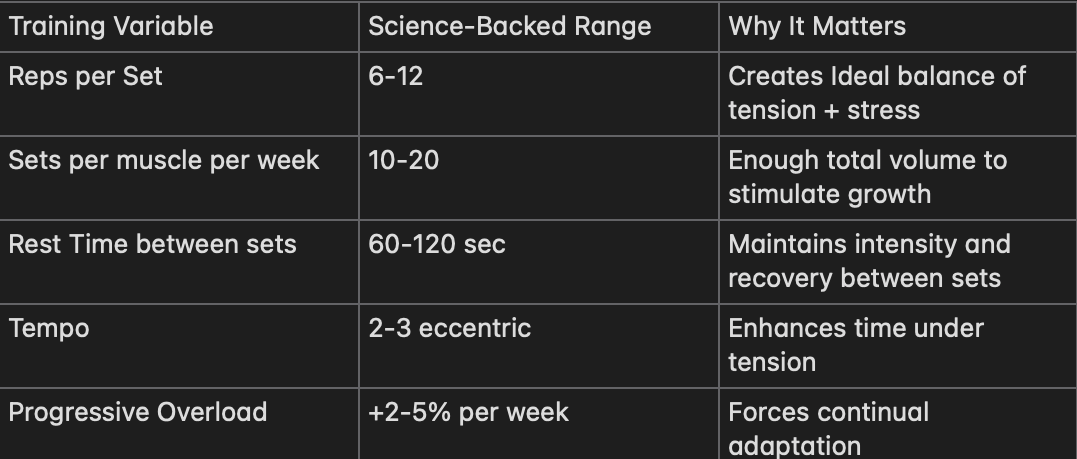
In this graph it shows you how many reps per set are beneficial for overall strength and growth as well as how many you should be doing a week. I want to break down some of these terms so you understand the graph as well.
Repetitions (Reps) - A rep is one complete movement of an exercise start to finish. For example: When you squat down and come back up to the starting position that’s 1 rep. Or if you curl a dumbbell up and lower it down once, that’s 1 rep.
Sets - A set is a group of reps done together before taking a break. For example: If you do 10 squats then rest, that is one set done. Many exercise plans will say something like “3 sets of 8-10 reps” that means you’ll do 8-10 squats then rest then repeat that 2 more times to achieve a total of 3 sets.
Eccentric and Concentric Phase:
Eccentric - when the muscle lengthens under tension (ie. lowering the weight back down slowly)
Concentric - when the muscle shortens as it contracts (ie. lifting a weight)
The eccentric part of each movement is very important for muscle growth — it’s where the most of the micro-tears in the muscle fibers occur, which later repair and grow stronger.
Progressive Overload - Means to gradually increase the challenge/weight/tension on your muscles over time so they keep getting stronger and growing.
With that knowledge referring back to the graph, studies show that doing 6-12 reps per set provides most results as well as 10-20 sets a week. For example you would do 4 set of 6-12 squats Monday then another 4 sets of 6-12 squats on Thursday, that puts you at 8 sets for the week for your hamstrings, quads, and glutes since squats are a compound movement. Rest time in-between sets is also very important to ensure you are resting for about 1-2 minutes prior to beginning your next set so as not to fatigue yourself. The tempo is how long your muscle is in the stretched position, advising you should be at the lowest point of your squat for example for 2-3 seconds. It is the same also advised that you increase the weight and/or tension on your muscles by 2-5% each week to ensure your muscle continue to grow. If you continue to put the same stress on your muscles they adapt and you can plateau meaning the muscle has no need to change and will no longer grow. You can apply progressive overload in many ways such as adding more weight, doing more reps, increasing sets, or slowing down your tempo.
Nutrition — The Fuel Behind Hypertrophy
Muscle growth doesn’t just happen in the gym, it’s fueled by what you eat. Whether your goals is to gain size or lose fat while building muscle, your nutrition controls how your body responds to training.
If you’re trying to gain muscle a caloric surplus is needed. To build new muscle tissue, your body needs extra energy — this means eating slightly more calories than you burn each day (ie. a caloric surplus). This gives your body the building blocks to repair muscle fibers and grow stronger.
Focus on:
Protein: ~ 1gram per pound of bodyweight.
Carbs: 2-3 grams per pound to fuel intense workouts and recovery.
Fats: 0.3-0.5 grams per pound to support hormone health.
If you’re trying to lose fat a caloric deficit is needed. You can still build or maintain muscle while losing fat but it is trickier. The key is to lift heavy and/or again referring to the chart and the description below it increasing reps, set or slowing tempo. Staying in a small caloric deficit of about 200-500 calories below maintenance helps the body prioritize burning fat instead of muscle tissue.Focus on:
Protein: 1-2 grams per pound of bodyweight to prevent muscle loss.
Carbs: 1-1.5 grams per pound, enough to fuel your workouts (quality carbs like rice, oats, or potatoes)
Fats: 0.3-0.4 grams per pound, to again support hormone heath.
Recovery, Consistency, and the Kaizen Mindset
Sleep is very important to recovery and is recommended 7-9 hrs a night for proper recovery and growth. The body does a lot of healing and hormone leveling when sleeping. Remember that exercise, growth, and a routine are not always perfect nor linear. There will be ups and downs trying to figure out what works for you but trying each day is what will give you the results you want. Small steps each day lead to greatness in the long run.
Thank you again for visiting today, have a great day always Wolf Pack!
References:
Schoenfeld, B. J. (2010). “The Mechanisms of Muscle Hypertrophy and Their Application to Resistance Training.” Journal of Strength and Conditioning Research.
Morton, R.W., et al. (2016). “A systematic review, meta-analysis and meta-regression of the effect of protein supplementation on resistance training-induced gains.” Frontiers of Physiology.
Phillips, S.M. (2014). “A brief review of critical processes in exercise-induced muscular hypertrophy.” Sports Medicine.